














When selecting interior materials, most people focus on color, durability, moisture resistance, or price. Yet one increasingly important criterion is often overlooked: formaldehyde emission levels.
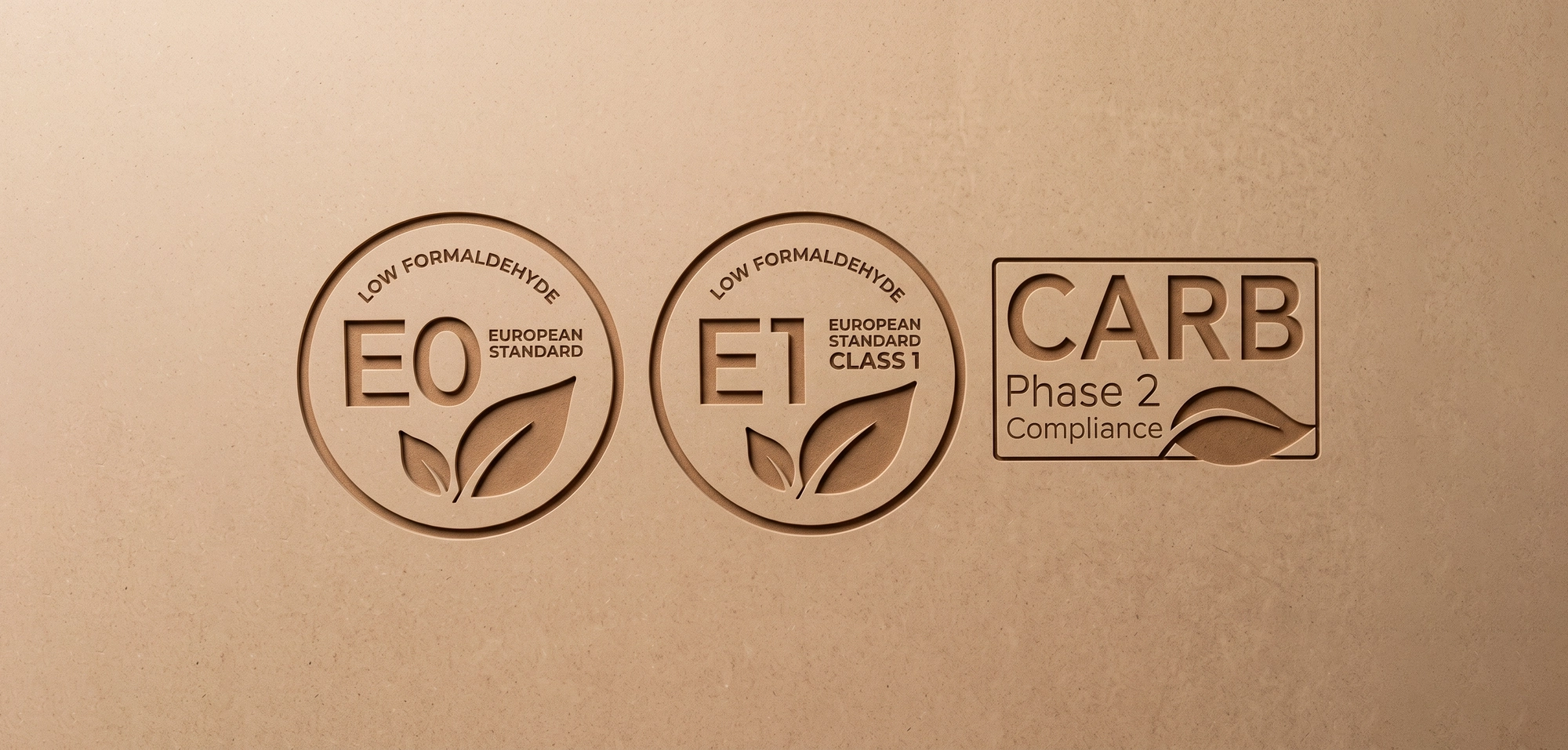
Labels such as E1, E0, and CARB P2 frequently appear on engineered wood panels and premium interior materials. These are more than technical specifications. They indicate how well a product controls formaldehyde emissions, helping architects, designers, developers, and homeowners make informed decisions about indoor air quality and material performance.
So what do these standards mean? How do they differ? And which one is best suited for modern interior projects?
What is formaldehyde?
Formaldehyde is a naturally occurring organic compound that is also widely used in industrial manufacturing. In the furniture industry, it is primarily associated with the adhesive systems used to bond wood fibers or particles when producing materials such as MDF, HDF, particleboard, and plywood.
This often leads to the misconception that engineered wood products are inherently unsafe. In reality, the key consideration is not whether formaldehyde is present, but how much is released into the indoor environment during the product’s service life. Thanks to advances in manufacturing technology and low-emission adhesive systems, today’s high-quality engineered wood products are designed to maintain very low emission levels and must meet rigorous testing requirements before entering the market.
This is why certifications such as E1, E0, and CARB P2 have become important indicators of product quality.
Why do formaldehyde emission standards matter?
A healthy indoor environment depends on more than attractive design. It also depends on the quality of the air inside the space. People spend an estimated 80 to 90 percent of their time indoors, whether at home, in offices, hotels, or commercial buildings. Choosing low-emission materials can therefore contribute to better indoor environmental quality and aligns with the growing global emphasis on healthier living spaces.
To support this objective, many countries and regions have established regulations that limit formaldehyde emissions from interior materials.
What is E1 standard?
E1 is one of the most widely recognized formaldehyde emission classifications in Europe under the EN standards framework.
It represents a commonly accepted emission limit for interior materials intended for residential and commercial applications. Most reputable European manufacturers produce engineered wood products that comply with, or exceed, E1 requirements. Because of its widespread adoption, E1 has become a benchmark for quality and regulatory compliance in many international markets.
What is E0?
While E1 is a well-established standard, E0 is generally used to describe products with even lower formaldehyde emissions.
Many manufacturers use the term E0 to identify materials intended for environments where indoor air quality is a particularly important consideration. However, consumers should note that E0 is not a universally harmonized international standard. Its definition and testing methodology may vary depending on the country, certification body, or manufacturer.
For this reason, it is advisable to review the accompanying test reports and certification details rather than relying solely on the E0 label.
What is CARB P2?
Unlike E1 and E0, which are commonly referenced in Europe and Asia, CARB P2 (California Air Resources Board Phase 2) is a regulatory standard established in the United States.
It specifies formaldehyde emission limits for engineered wood products, including:
- MDF
- HDF
- Particle Board
- Hardwood Plywood
CARB P2 is widely regarded as one of the world’s most rigorous formaldehyde emission standards. To achieve certification, manufacturers must not only produce compliant materials but also implement ongoing quality control systems and undergo regular audits by accredited third-party certification bodies.
For this reason, CARB P2 compliance has become a common requirement for companies supplying products to the U.S. market.
How do E1, E0, and CARB P2 compare?
Although these classifications all relate to formaldehyde emissions, they serve different purposes.
- E1 is the widely accepted European benchmark for low-emission interior materials.
- E0 generally refers to products with very low emissions, although the classification is not internationally standardized.
- CARB P2 is a legally regulated U.S. standard that requires strict emission limits, ongoing factory quality control, and independent third-party certification.
Rather than asking which standard is “best,” it is more useful to understand which standard is appropriate for your project, market, and regulatory requirements.
The future of interior materials is low emission
The interior materials industry is moving steadily toward products that are safer, more sustainable, and more transparent.
In addition to traditional performance criteria such as moisture resistance, scratch resistance, and color stability, formaldehyde and VOC emissions have become increasingly important considerations when selecting materials. This trend is particularly evident in projects pursuing green building certifications such as LEED, WELL, and EDGE, where low-emission materials often play an important role in achieving indoor environmental quality objectives.
As awareness of healthy buildings continues to grow, low-emission materials are becoming not only an international expectation but also an emerging standard within Vietnam’s interior industry.
Choosing interior materials goes beyond appearance
A high-quality panel is defined by more than its attractive surface, durability, or moisture resistance. It should also be engineered to meet recognized emission standards that support healthier indoor environments.
Understanding the differences between E1, E0, and CARB P2 enables homeowners, architects, designers, and developers to make more informed material selections based on project requirements and long-term performance.
Ultimately, the value of an interior space is measured not only by how it looks, but also by the confidence it provides to the people who live, work, and spend time within it.